Use the full formula
For a temperature reading, Fahrenheit equals Celsius × 9/5 + 32. The reverse is (Fahrenheit − 32) × 5/9. NIST describes the Celsius and Fahrenheit scales. Because their zero points differ, multiplying by 1.8 alone gives the wrong reading.
An interval is different
A change of 10 °C corresponds to a change of 18 °F; the +32 offset cancels when comparing differences. Specify whether you are converting a reading (“the room is 20 °C”) or a change (“it warmed by 10 °C”). The unit and context determine the operation.
Anchor the formula with familiar points
Water freezes at 0 °C and 32 °F under ordinary reference conditions, which reveals the 32-degree offset. At 100 °C the Fahrenheit scale reads 212 °F, a 180-degree span for a 100-degree Celsius span. That explains the 9/5 multiplier. These anchors are useful checks: a warm 20 °C room should not become 36 °F, because 36 °F is close to freezing.
Do not mix reading and difference formulas
If a forecast moves from 10 °C to 20 °C, the rise is 10 °C or 18 °F, not 50 °F. The absolute readings are 50 °F and 68 °F; subtracting them gives the 18 °F change. When a question says “convert 10 degrees”, ask whether it means a temperature reading or a difference. That small clarification prevents applying +32 to a change where it does not belong.
Try it with your numbers
Try “Convert 20 degrees Celsius to Fahrenheit.” A clear temperature reading lets the tool apply the offset as well as the scale factor. If you mean a change in temperature, phrase it as “a rise of 10 Celsius degrees” rather than an absolute reading of 10 °C. The two interpretations produce different Fahrenheit numbers.
Try it yourself
A worked example
Room temperature
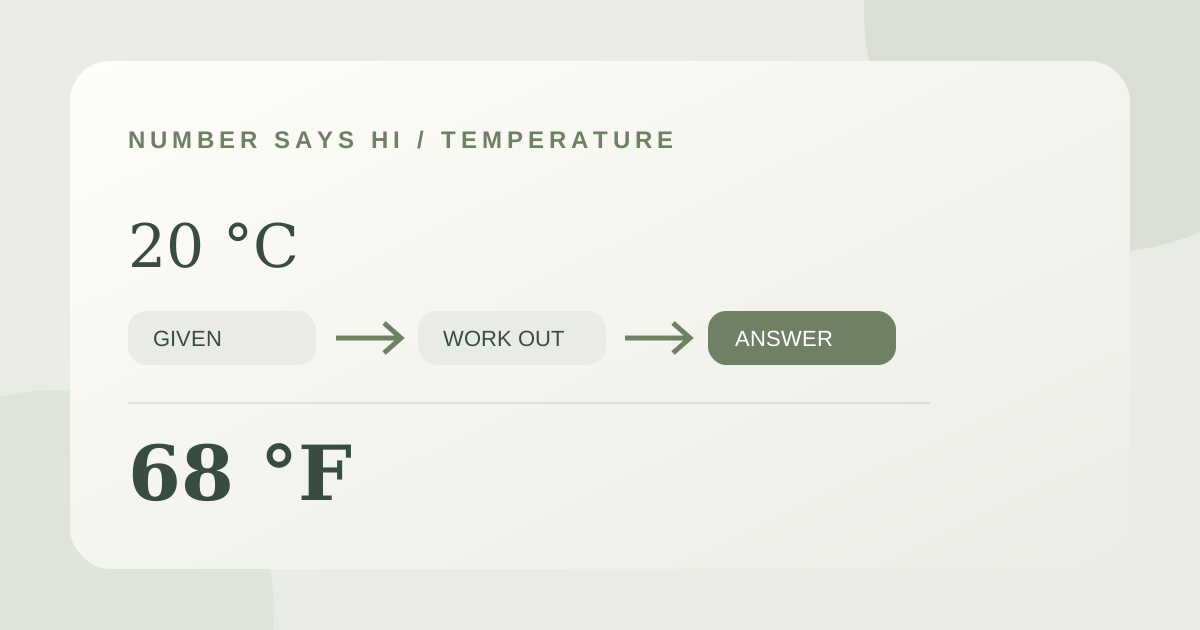
“Convert 20 °C to °F.”
- 20 × 9/5 = 36
- 36 + 32 = 68
Sources and further reading
- SI Units: TemperatureNational Institute of Standards and Technology · accessed 2026-10-18