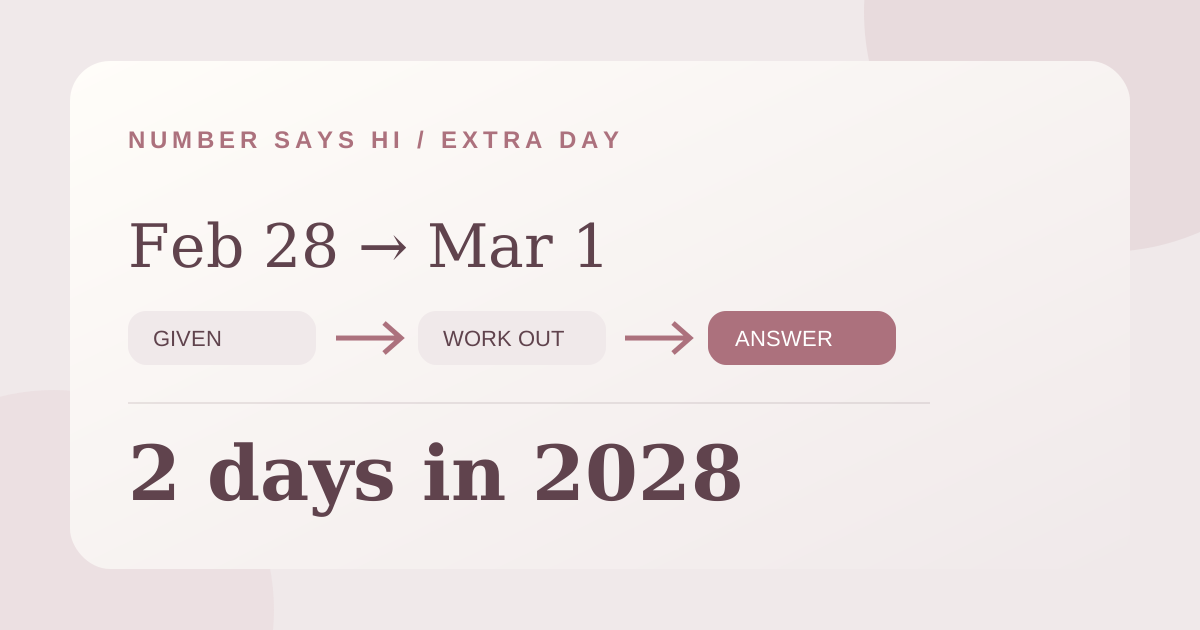
The extra day belongs to February
A Gregorian leap year has 366 days because February has 29. Years divisible by four are usually leap years, but century years must also be divisible by 400. Thus 2000 was a leap year, while 1900 was not. The US Naval Observatory calendar chapter states the Gregorian rule.
Check examples around the boundary
From 28 February to 1 March is two elapsed days in a leap year, passing through 29 February; it is one day in a common year. For “one month after 29 February” or annual anniversaries, a policy choice may be needed because some target months or years lack that numbered date. Avoid silently assuming a rule.
A practical four-step check
First check divisibility by four. If the year is not divisible by four, it is common. If it is divisible by four and not by 100, it is leap. If it is divisible by 100, it must also be divisible by 400 to be leap. That is why 2028 and 2000 have 29 February, while 1900 does not. The century exception matters for software and long-range schedules even if it rarely appears in an everyday booking.
The extra day changes intervals, not every anniversary rule
Leap day adds one elapsed day to a period that crosses it. It does not by itself determine how an anniversary on 29 February should be observed in a non-leap year; organisations and jurisdictions can choose different conventions. Likewise, adding one calendar year to a leap-day date needs a rule when the target year has no 29 February. Ask for the convention when that detail changes the result.
Try it with your numbers
Try “How many days are between 28 February 2028 and 1 March 2028?” The two-day answer lets you check that 29 February was included. You can compare the same dates in 2027 to see the one-day common-year interval. Avoid interpreting annual contract anniversaries from this calculation alone, because a leap-day anniversary may have a specific governing convention.
Try it yourself
A worked example
Cross leap day
“How many elapsed days from 28 February 2028 to 1 March 2028?”
- 28 Feb → 29 Feb = 1 day
- 29 Feb → 1 Mar = 1 day
Sources and further reading
- Explanatory Supplement to the Astronomical Almanac: CalendarsUnited States Naval Observatory · accessed 2026-10-18