Divide by the fraction you know
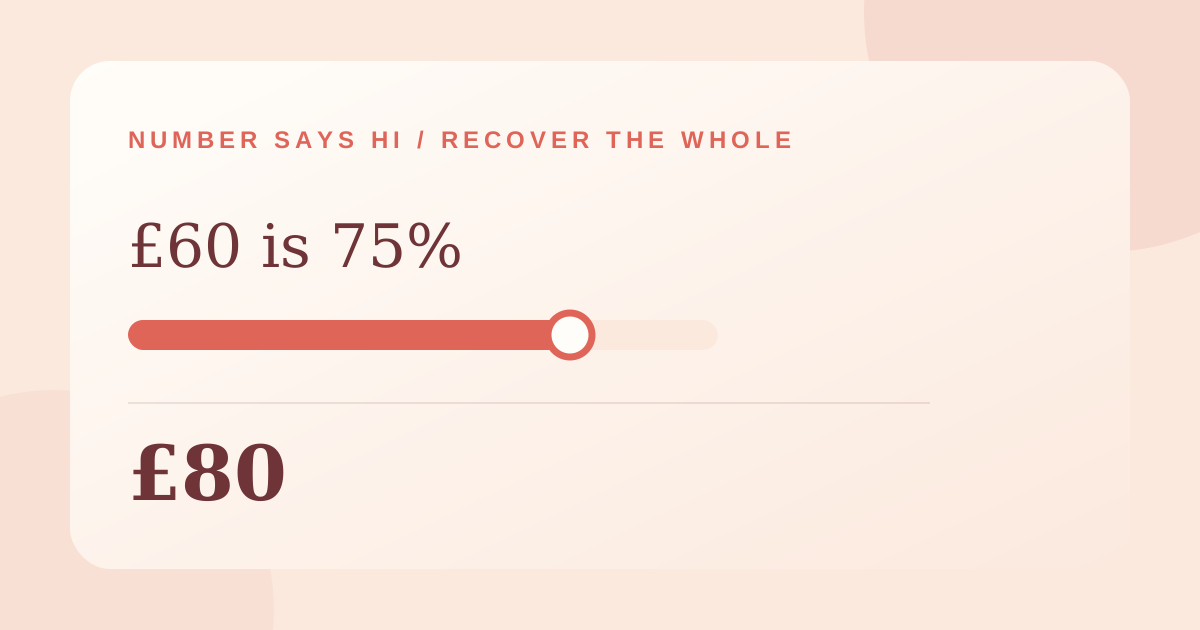
If £60 is 75% of an original amount, divide £60 by 0.75 to find 100%. If a sale price reflects 25% off, the paid price is 75% of the original, so the same calculation applies. OpenStax explains solving for the unknown base.
Check by going forwards
Multiply the recovered amount by the known percentage. If the result is not the amount you started with, check whether the percentage means “off”, “remaining”, or “of”. A 25% discount and a price that is 25% of original lead to very different bases.
Why adding the discount back fails
The £60 sale price in the example is 75% of the original. Adding 25% of £60 gives £75, but 25% of the original £80 is £20. The error comes from using the reduced price as the base for the increase. Division by the remaining fraction is the reliable method. If the displayed discount is rounded, your recovered original may also be approximate; a store may round currency at different stages.
Use the wording to choose the fraction
“After a 20% rise” means the new value is 120% of the old one, so divide the new value by 1.20. “After 20% off” means it is 80%, so divide by 0.80. “£30 is 20% of the total” means divide £30 by 0.20. All three are reverse percentages, but the divisor follows the relationship given. Write that relationship as a sentence before doing the division.
Try it with your numbers
Try “£60 is 75% of what amount?” when you know the remaining fraction. For a sale sign saying 25% off, state that £60 is the 75% payable portion. This wording avoids asking the tool to guess whether 25% means the amount removed or the amount remaining. Check the result forwards after it is shown.
Try it yourself
A worked example
Recover a marked price
“A £60 sale price is 25% off. What was the original?”
- 100% − 25% = 75% payable
- £60 ÷ 0.75 = £80
- £80 × 0.75 = £60 check
Sources and further reading
- Prealgebra 2e: Solve General Applications of PercentOpenStax · accessed 2026-10-18
- Prealgebra 2e: Sales Tax, Commission, and DiscountOpenStax · accessed 2026-10-18