Subtract the saving
A discount is a percentage of the original marked price. Find the saving by multiplying the original price by the discount as a decimal, then subtract it. The equivalent shortcut is original price times the percentage still payable. With 30% off, you pay 70%. OpenStax shows discount applications.
Watch the order of multiple discounts
Two successive discounts are applied to different bases. A 20% reduction followed by 10% off is 0.8 × 0.9 = 0.72 of the original price: 28% off overall, not 30%. Other charges or taxes may be applied after the discount, depending on the offer and location.
Compare the final payable amount
Two stores can advertise different discount percentages yet end at the same price because their starting prices differ. Calculate the final price for each offer, then add any delivery charge, required membership, or other known cost before comparing. A larger percentage on a much higher marked price is not automatically the better deal. The calculator can solve the arithmetic once you provide all relevant amounts; it cannot verify that a marked price was previously offered.
A quick check for stacked offers
For a £100 item with 20% off followed by a further 10% off, the first price is £80 and the second discount is £8, leaving £72. The second 10% applies to £80, not the original £100. If a voucher says it applies before or after another reduction, follow that rule. Keep the sequence in the steps so you can spot a misplaced base.
Try it with your numbers
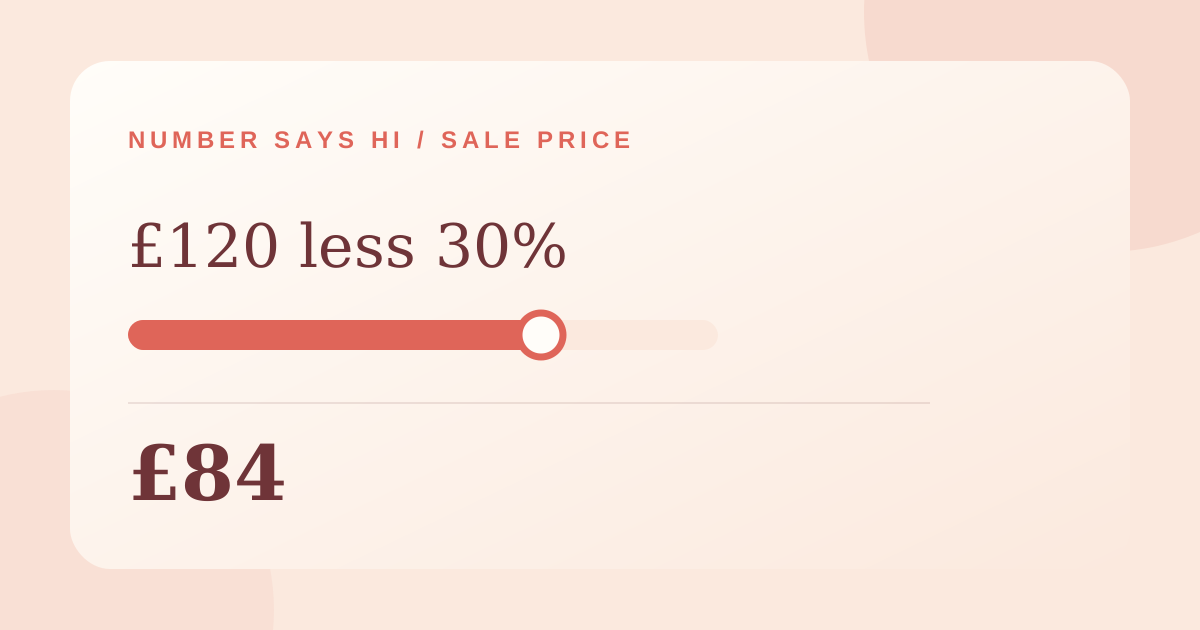
Try “What is 30% off £120?” to see the amount saved and payable price. For two offers, work through each stage with its own base: first ask for 20% off £100, then ask for 10% off the resulting £80. Check voucher rules outside the calculator before treating the arithmetic as the actual checkout price.
Try it yourself
A worked example
A jacket on sale
“What is 30% off £120?”
- £120 × 0.30 = £36 saving
- £120 − £36 = £84
Sources and further reading
- Prealgebra 2e: Sales Tax, Commission, and DiscountOpenStax · accessed 2026-10-18