Pick a sharing rule first
An equal split is easy but may feel wrong when orders differ. For proportional sharing, divide each person’s item subtotal by the combined item subtotal. Apply that fraction to shared tax or tip, then add it to their own items. This is an arithmetic method; the group must choose whether it is the appropriate rule.
Reconcile the total
Check that all individual shares add back to the full receipt. Round only when assigning final currency amounts; rounding every intermediate fraction can create a small remainder. If one person paid for a shared item, agree how to distribute it before calculating.
What proportional sharing does
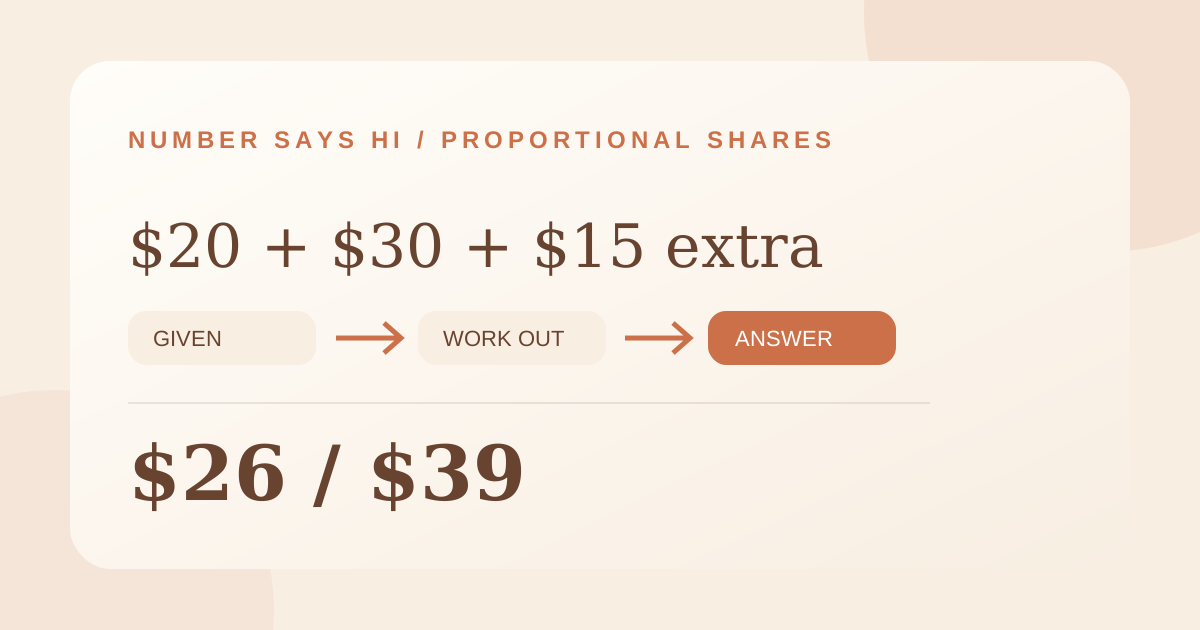
Each diner receives the same percentage uplift on their own item cost. In the $20 and $30 example, the $15 of extras is 30% of the $50 item total. Adding 30% to each order gives $26 and $39. That arithmetic is equivalent to assigning 40% and 60% of the extras. It is useful when shared charges scale naturally with what each person consumed, but it is one agreement among several possible sharing rules.
Handle exceptions explicitly
If the shared extras include a flat booking fee, a group may prefer to split that fee equally and allocate only the percentage-based charges proportionally. If someone bought an item for the table, decide who shares it before computing each subtotal. For a group of many people, use a simple list of item subtotals and a check sum: all final shares must add to the receipt total. A generic calculator can assist with each arithmetic step even when it does not automate the full allocation policy.
Try it with your numbers
Use a short sequence of arithmetic questions instead of assuming the tool knows your group’s fairness rule. First ask what 40% and 60% of the $15 shared extras are, then add those results to the $20 and $30 item subtotals. Compare the two final shares with the $65 receipt. Change the method if some charges should be equal rather than proportional.
Try it yourself
A worked example
Two different orders
“Orders are $20 and $30, with $15 shared extras. How could we split $65 proportionally?”
- Items total = $50
- $20 ÷ $50 = 40%; $30 ÷ $50 = 60%
- Extras: $15 × 40% = $6; $15 × 60% = $9
Sources and further reading
- Prealgebra 2e: Solve General Applications of PercentOpenStax · accessed 2026-10-18